Blog4 min read
When Document Parsing Automation Is Worth It (and When to Buy Instead of Building on n8n)
Everyone in the automation subreddits is wiring up the same workflow this month. PDF in, OCR node, LLM node, structured JSON out. There are three free templates for it on the n8n site and a dozen YouTube walkthroughs, half of them made by people on day 18 of an internship.
I have built these too. A Make pipeline for an Upwork client that pulled fields off invoices and dropped them into a sheet. It worked. It also took an afternoon.
That afternoon is the whole problem. If the build takes an afternoon and interns ship it as a portfolio piece, nobody is paying top dollar for the build. The money in document automation is not in the wiring. It is in the decision that comes before the wiring, and most people skip straight past it.
The Threshold Nobody Calculates
Automating document extraction is only worth it above a volume line. Below that line you are spending engineering time to replace a person who spends twenty minutes a week retyping numbers.
Do the math before the build. Documents per month, times minutes of manual handling each, times a loaded hourly rate. A team processing 200 invoices a month at four minutes each is burning maybe 13 hours. Real, but a junior handles it between other tasks. A team processing 40,000 shipping documents a month is burning a headcount, and one mis-keyed customs value triggers a chargeback that costs more than the retyping ever saved.
Only the second team should automate. The first team should buy a coffee for whoever does the retyping. The build cost is roughly the same for both. The value is not close.
So the first question is never “how do I parse this in n8n.” It is “does my throughput clear the line.” Most inbound requests I see fail that test and do not know it.
Above the Line, the Question Flips
Say the volume is real. Now the interesting fork opens, and it is not a wiring question either.
You can build it on n8n. You can buy a parser like Parseur or LlamaParse or a vendor OCR API. You can commission something custom. The template crowd only shows you the first option because it is the one that films well.
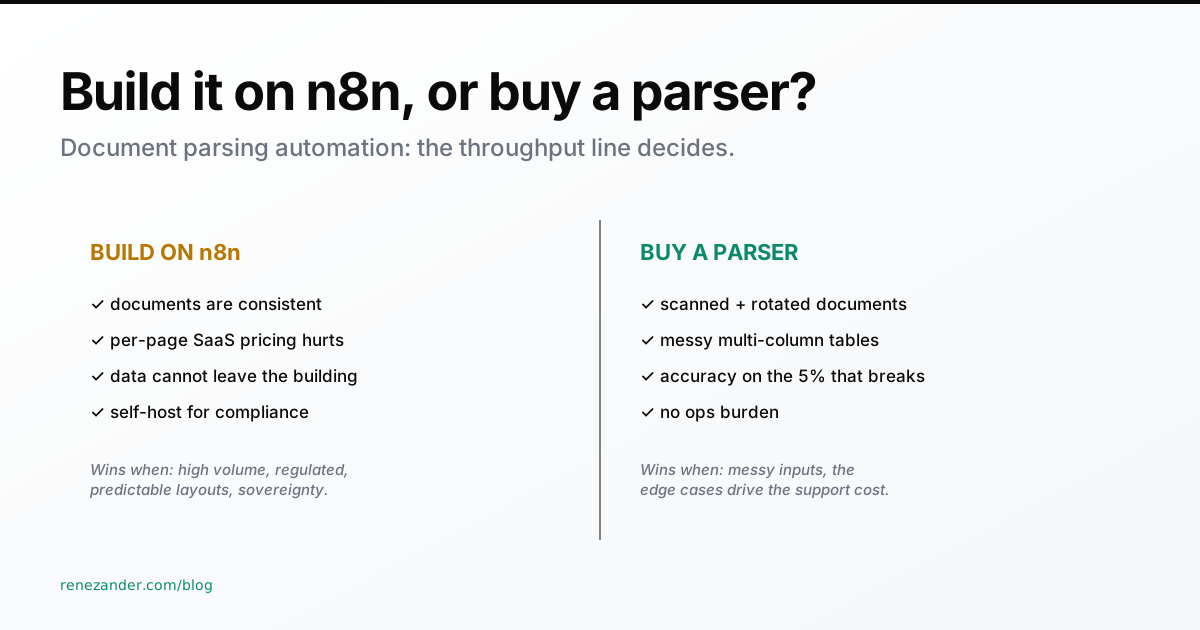
Buy wins more often than builders admit. A dedicated parser handles scanned documents, rotated tables, and messy multi-column layouts that the native n8n PDF node cannot touch. You are paying for accuracy on the documents that break, which is exactly the 5 percent that generates 95 percent of the support tickets. That 5 percent is where the build hours go and where the client feels the pain.
Build wins when your documents are consistent, your volume makes per-page SaaS pricing hurt, or your data cannot leave the building.
The Part That Actually Pays
That last one is the reason a build survives contact with a regulated buyer. A Krankenversicherer or a Bank in the DACH region cannot pipe patient records or account statements through a US parsing API and call it a day. Sovereignty is the constraint the whole architecture bends around, and it decides the stack before anyone opens a node editor.
This is where a self-hosted n8n instance with a local model stops looking like the cheap option and starts looking like the only compliant one. Not because self-hosting saves money. It often does not, once you count the ops burden. Because the data never leaves a boundary the client controls.
That reasoning is the sentence a decision-maker pays for, not the workflow: your volume clears the line, your documents are messy enough that a parser earns its fee, but your compliance posture forces the parser to run inside your own walls, so here is the hybrid that holds all three.
What I Actually Sell
I do not sell the afternoon of wiring. Anyone can do the afternoon, and the free templates already did.
I sell the hour before it. Where does your throughput sit. Which documents break and how often. Build, buy, or hybrid. Cloud API or self-hosted for the compliance line. Get that hour wrong and you either automate something that was never worth automating, or you pipe regulated data somewhere it was never allowed to go. Both are more expensive than the build ever was.
Look at whatever document workflow you are about to spend a weekend building. Do you know your monthly volume, your break rate, and whether your data is allowed to leave the building? If you cannot answer all three, you are not ready to open n8n yet.
Your agents answer from whatever the retriever finds, and too often that is last quarter's truth. I build the context layer they answer and act from: a temporal knowledge graph that keeps every fact with its source and the time it held, reads with each person's own permissions, and writes nothing without a person's approval. On your own tenant, billed by the hour, step by step.