Blog5 min read
Temporal Knowledge GraphFive Tests for Conflicting Sources
A newer message can be accurate and still be the wrong authority for a decision. Before an AI agent resolves a disagreement between two records, define who can settle it, which period each claim covers and what the agent may do while the conflict remains open.
A temporal knowledge graph can represent changing relationships. The useful acceptance test is whether it handles a disagreement without quietly turning one source into the truth.
Start with one disputed field
Consider a fictional delivery project. The order system records an agreed delivery date of 12 December. A project chat from 20 November says, “We should aim for 19 December.” A signed change request arrives on 23 November and confirms 19 December, effective from 21 November.
These records describe three different things: an existing commitment, a proposal and an accepted change. Sorting them by message date would hide that distinction.
For this exercise, assume the business owner has defined the signed change request as the authority for changing an agreed delivery date. That is an explicit example policy, rather than a universal rule for contracts or project delivery.
The temporal knowledge graph guide explains the underlying model. Here, the question is narrower: what should your system return as those three records arrive?
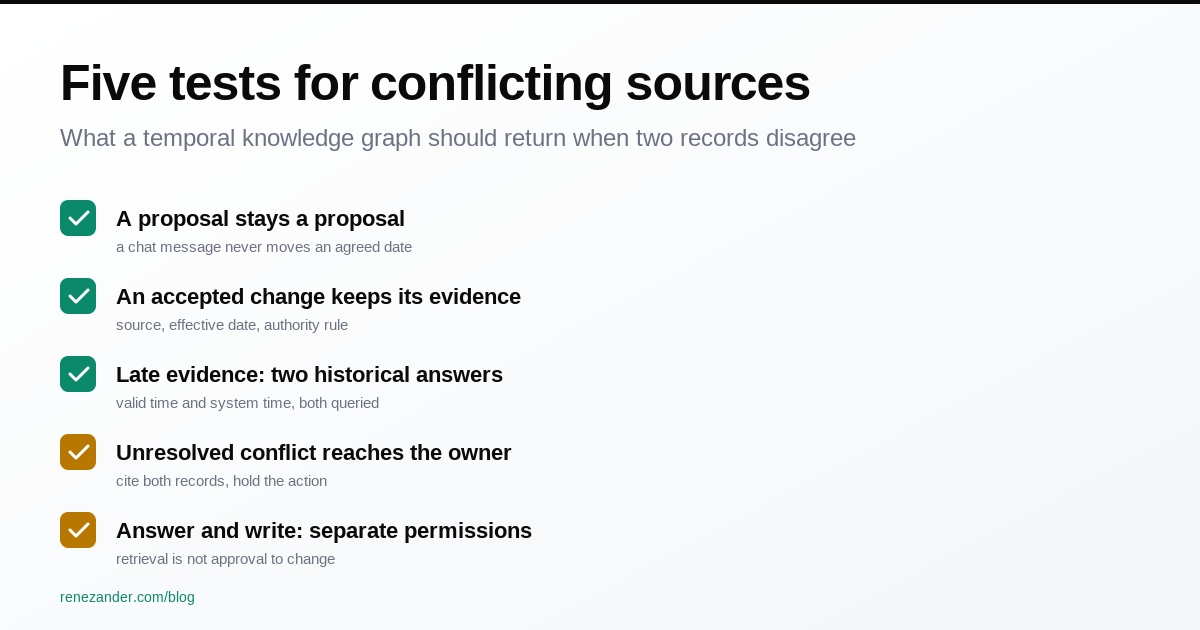
Test 1: A proposal stays a proposal
Load the order record and the chat message first. Ask, “What is the agreed delivery date?”
The expected answer is 12 December, with a link to the order record. The agent may also report the proposed move to 19 December, clearly labelled as a proposal.
A useful result explains the distinction: the chat proposes a change, while the agreed date remains unchanged under the policy for this exercise. If the agent updates the commitment from that chat alone, the test fails.
Keep the extracted claim and its status together. Losing the word “proposed” during extraction changes the meaning before retrieval even begins.
Test 2: An accepted change keeps its evidence
Now add the signed change request. Ask the same question again.
The expected answer becomes 19 December, effective from 21 November, with the change request as evidence. The previous commitment remains available for historical questions.
For the resolved claim, retain enough information to inspect the decision: the project and field, old and new values, source record, effective date, recording time and the authority rule used. Those are proposed acceptance criteria for your implementation, rather than a claim that every graph framework provides them automatically.
Also test the exact source link. A citation that opens an unrelated project gives the reviewer very little protection.
Test 3: Late evidence produces two historical answers
The change took effect on 21 November, but the system received it on 23 November. After ingestion, ask:
| Question | Expected result in this example |
|---|---|
| What was the agreed date on 22 November, using the corrected history? | 19 December, supported by the accepted change effective from 21 November. |
| What date did this system have recorded on 22 November? | 12 December; it had yet to receive the accepted change. |
The first query concerns when the claim held. The second concerns when the system recorded it. These are the valid-time and system-time dimensions described in XTDB’s explanation of bitemporality.
Storing two timestamps is only part of the work. Run both questions against retained history and check that the query path makes the distinction.
Test 4: An unresolved disagreement reaches the right owner
Change the example again. Replace the signed change request with a second, incompatible order record, and give neither record precedence under the example policy.
The useful response identifies an unresolved conflict, cites both records and names the role authorised to decide. It holds any action that depends on choosing a delivery date.
Test this with the records supplied in both orders. If reversing ingestion order reverses the answer without a policy reason, arrival order is deciding your business rule.
The same principle applies when three messages repeat a claim copied from one source. Repetition should remain traceable to its origin rather than becoming independent confirmation.
Test 5: An answer and a write have separate permissions
Finally, give the agent the accepted date and ask it to update the order system.
Check the write boundary separately. Correct retrieval establishes which claim the answer follows; your workflow still needs to establish whether this user and this agent may make that change, and which approval applies.
Include a user who can read the project chat but cannot read the change request. Test the answer, citations and conflict message for that user. Even a warning about a disagreement can reveal information from a restricted source.
Keep a small acceptance pack
Save the fictional records, authority policy, user permissions and expected answers together. Run the five cases before and after changing extraction, retrieval or update rules.
Compare the same cases with your existing system of record and its retained history. If that simpler route answers them reliably, you already have a useful baseline.
The practical output is a short record of where the workflow fails: claim status, source authority, historical reconstruction, unresolved conflict or permission to act. Bring one anonymised failure, its two sources and the role that can resolve it to a context-layer scoping conversation.
Your agents answer from whatever the retriever finds, and too often that is last quarter's truth. I build the context layer they answer and act from: a temporal knowledge graph that keeps every fact with its source and the time it held, reads with each person's own permissions, and writes nothing without a person's approval. On your own tenant, billed by the hour, step by step.