Blog3 min read
State, Not StepsWhy Your Workflow Automation Has No Memory
Your workflow has run clean for 4 months. Ask it what it decided about that one customer last Tuesday.
It does not know. It never knew. A run started, worked through its steps, wrote a result and disappeared. What is left is an execution log: a record that something happened, not a record of what holds true since.
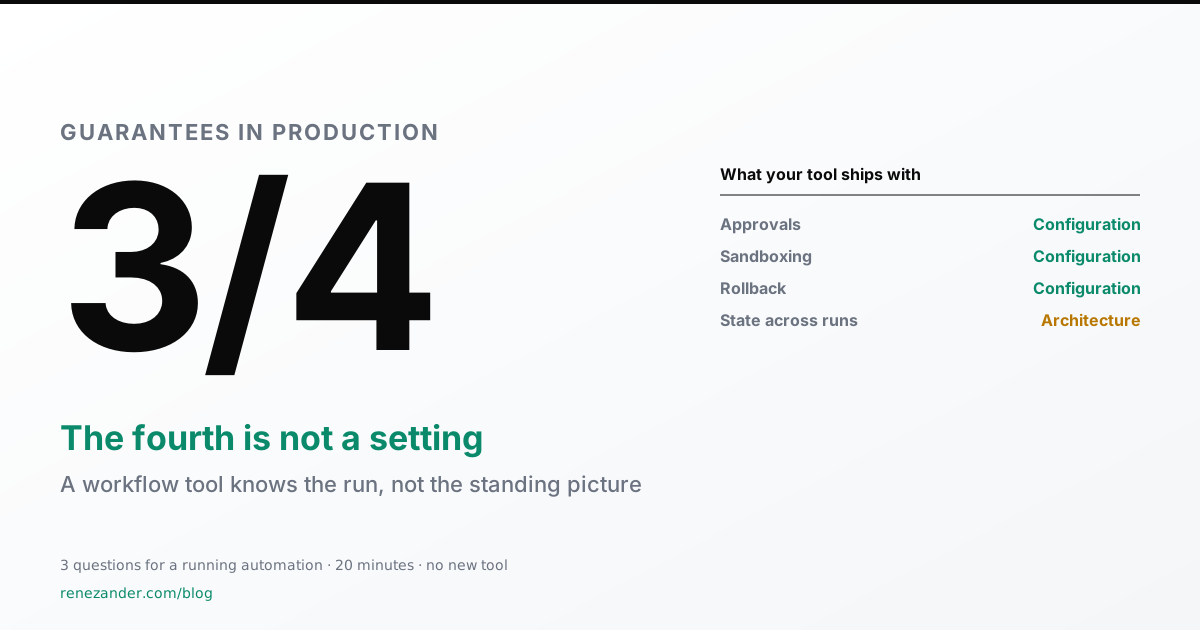
Four guarantees separate a production system from a demo: memory, approvals, sandboxing and rollback. 3 of them are a setting in your workflow tool. The fourth is architecture, and almost nobody builds it.
3 of 4 guarantees are configuration
Approvals are a node that waits. Sandboxing is a separate runner and its own set of credentials. Rollback is a restore point and the discipline to set one. You can wire all three in an afternoon, and the common tools ship them.
Memory, no. A workflow tool is built as an execution engine, not a knowledge store. It knows the current run. It does not know the standing picture.
No flaw in any particular product. Shape. Asking an execution engine to remember is looking in the wrong place.
State is not a log
The usual objection: we log everything.
A log answers what happened. State answers what holds true now. Not the same question, and the second one is the expensive one.
“The supplier wrote on the 12th that the delivery slips” is in the log. “The delivery date is October 6” is nowhere. Someone would have to read the message and promote it into a claim about the world. That promotion is the step an execution log never takes.
As long as nobody takes it, every run takes it again. Your agent reads the same mail a fourth time and reaches, a fourth time, a conclusion nobody wrote down. That is not only expensive. It is unauditable, because there is no point at which a person decided.
The standing picture is the work
Across the 5 business graphs I run there are currently 2,161 edges. They did not fall out of runs. Each one passed a rule that decided whether it commits automatically or belongs in front of a person. Which three rules those are, and why most facts should never reach a person, is in the routing rules for agent memory approval gates.
The number that matters is the second one: 735 ingested items produced 1,980 facts, and 87 of them went through the gate. The rest passed because a rule could carry them.
Where that standing picture lives is secondary. One option without a new database is the task app you already curate every day.
That is the point. Memory is not storing more. Memory is deciding what is allowed to stay, and running that decision so somebody can still read it back later. Without that rule a store does not grow. It piles up.
What you can check this week
Take one running automation and ask it 3 questions.
What holds true right now, without a new run starting? If the answer can only be reconstructed from a log, you have history. You do not have state.
Who decided that it holds? “The system” is not an answer. That is a promotion with nobody’s signature on it.
And if it was wrong? If the correction means somebody hand-searches a database, rollback is a claim, not an operational path.
Three answers, 20 minutes. You need no new tool for it, only an honest pass over what is already running.
A pilot shows the steps work. Production asks what the system knows. Which of your automations could answer that today?
Your agents answer from whatever the retriever finds, and too often that is last quarter's truth. I build the context layer they answer and act from: a temporal knowledge graph that keeps every fact with its source and the time it held, reads with each person's own permissions, and writes nothing without a person's approval. On your own tenant, billed by the hour, step by step.