Case study5 min read
AI Revenue Prioritization System Embedded in HubSpot CRM
For decision-makers, in 20 seconds
Problem
Sales works the pipeline by gut feeling and activity. Nobody can say with confidence which contact is actually worth a rep's week.
Solution
An AI layer directly inside HubSpot. Every contact gets an ICP fit score, the pipeline sorts itself by expected revenue, and every recommendation comes with a written rationale the rep can defend to leadership.
Business value
The most expensive resource in sales is the rep's week. This system decides every morning which contacts it flows into. No new tool and no new tab: it runs inside the HubSpot your team already has open.
Frame
Billed by the hour, phase by phase, acceptance criteria agreed before the start. Runs in your HubSpot account, your data stays with you.
The problem
HubSpot gives you ten thousand contacts and very little opinion about which to call first. The native lead-scoring plugin is a weighted sum of “opened an email” and “visited pricing page” — which tells you who has clicked around, not who is in your ICP. Reps learn to ignore it within a month.
The workaround in most DACH B2B orgs is a Tuesday-morning pipeline review: the sales manager picks ten accounts from instinct, the team dials them, the rest of HubSpot goes untouched. The cost is invisible — the ICP-perfect VP of Digital Transformation at a mid-size manufacturer who happened not to open an email this week sits in “New” status for six months until someone notices.
Bolt-on AI scoring tools (Clari, People.ai, Gong Engage) fix the scoring problem by taking you out of HubSpot. Your rep lives in a second tool, your managers read a third report, and the AI score never makes it back into the CRM that runs the sequences and the tasks. Adoption collapses within a quarter.
Want to design the same pattern for your HubSpot? The HubSpot AI Revenue Prioritization Template generates the property schema, the AI scoring prompt, and the pipeline ranking formula from five inputs.
The solution
A HubSpot-native decision layer. The AI runs on HubSpot’s own contact properties, reads from and writes back to HubSpot, and the rep never leaves the tool they already know.
Every contact gets six AI-populated properties, each a HubSpot custom property a manager can filter, group, and automate on:
- AI ICP Fit —
Strong / Moderate / Weak / Not a fit. Conditioned on title, seniority, company size, industry, geography, and firmographic signals. - AI Score — 0–100 composite, weighted by ICP fit, seniority, decision-maker signals, and recent intent. Weights are tuned per customer, not a vendor default.
- AI Tier —
Hot / Warm / Cold / Nurture. Derived from the score against thresholds the revenue team sets, not the vendor. - AI Next Step — one specific prescribed action, e.g. “Priority outreach within 24 hours — schedule discovery call to discuss AI automation opportunities.”
- AI Reasoning — 2–4 sentences of plain-language explanation. The rep can read it, agree or disagree, and defend the action to their manager without re-explaining “why this lead.”
- AI Version / Timestamp — model ID + run timestamp, so old scores can be distinguished from fresh ones.
Sequences, workflows, and dashboards all pick these up as first-class HubSpot properties. The rep opens the contact record and sees six rows of AI output alongside the name, email, and lifecycle stage — same UI, same muscle memory.
Automation that comes free once the properties exist:
- Round-robin assignment by tier — Hot leads route to senior AEs within 5 minutes, Warm leads to SDR pool.
- Sequence enrollment from tier change — a contact crossing Cold → Warm auto-enrolls in the MQL sequence.
- Manager dashboards — “Hot leads untouched > 24h” is a one-filter view, not a weekly report.
The results
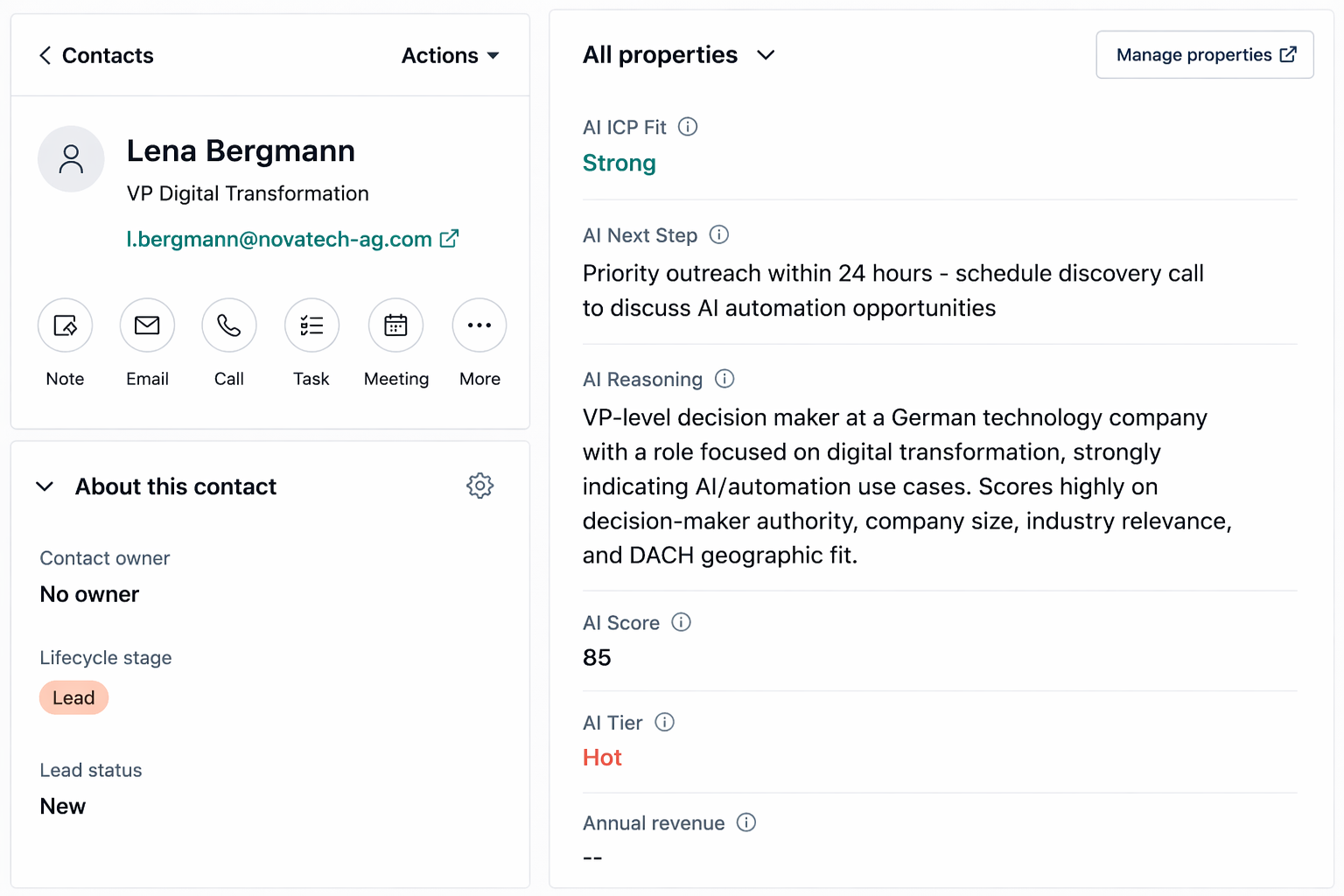
Numbers below reflect the system’s live state on a single contact record — Lena Bergmann, VP Digital Transformation, novatech-ag.com:
| HubSpot property | Value |
|---|---|
| AI ICP Fit | Strong |
| AI Score | 85 |
| AI Tier | Hot |
| AI Next Step | Priority outreach within 24 hours — schedule discovery call |
| AI Reasoning | VP-level decision maker at a German technology company with a role focused on digital transformation… scores highly on decision-maker authority, company size, industry relevance, and DACH geographic fit. |
| Lifecycle / Status | Lead / New |
Operational outcomes:
- Reps work the top of the queue, not the bottom of their inbox. The Hot-tier filter surfaces the top 5–10% of contacts by expected revenue, and the Next Step property tells them exactly what to do with each one.
- Managers review reasoning, not scores. “Why is Lena Bergmann a Hot lead?” answers itself in the AI Reasoning property — VP-level, DACH geo, digital-transformation focus, decision-maker authority. The conversation moves from “do we trust the score?” to “what is our move on this account?”
- No tool switching, no adoption cliff. Because every AI property is a HubSpot custom property, every existing workflow (sequences, round-robin, tasks, reports) works without modification.
Positioning
This is not a rip-and-replace of HubSpot. HubSpot remains the system of record, the sequencer, the task engine, the reporting layer. All this system does is add an AI opinion — ICP fit, score, tier, next step, reasoning — on top of the data HubSpot already has.
It is also not a replacement for Gong, Clari, or People.ai if you are a 500-seat revenue org with a dedicated RevOps team and a defined intent-data stack. Those tools do more. This one does less, inside a CRM you already pay for, with zero additional UI to train on.
If you are a DACH B2B team running HubSpot Sales or Marketing Hub, hitting the ceiling of HubSpot’s native scoring, and not ready to take on a bolt-on AI stack — this is the layer.
Stack & links
- HubSpot custom properties: 6 AI-populated fields on the Contact object
- Scoring engine: composite weighted model, customer-tuneable
- LLM reasoning: structured output (2–4 sentences), deterministic format
- Workflow hooks: HubSpot Workflows API for tier-change automations, sequence enrollment, round-robin
- Deployment: HubSpot OAuth app — no data egress beyond the inference call
- Privacy posture: compatible with DSGVO data-processing requirements; inference can run on-prem for regulated workloads
If you run a DACH B2B pipeline on HubSpot and the native scoring has stopped earning rep trust, I am happy to walk through your data. No slide deck, thirty minutes, you bring a sample of contacts and what good looks like.
Stack
- HubSpot custom properties (Contact object, 6 AI-populated fields)
- Composite scoring model (ICP fit + seniority + intent, tuneable per customer)
- LLM-generated reasoning (structured output, 2–4 sentences, deterministic)
- HubSpot Workflows API hooks (tier-change routing, sequence enrollment)
- HubSpot OAuth app — no data egress beyond the inference call
Next step
Similar project on your desk?
The fastest way to scope it is a conversation. Pick a slot right here:
Your agents answer from whatever the retriever finds, and too often that is last quarter's truth. I build the context layer they answer and act from: a temporal knowledge graph that keeps every fact with its source and the time it held, reads with each person's own permissions, and writes nothing without a person's approval. On your own tenant, billed by the hour, step by step.